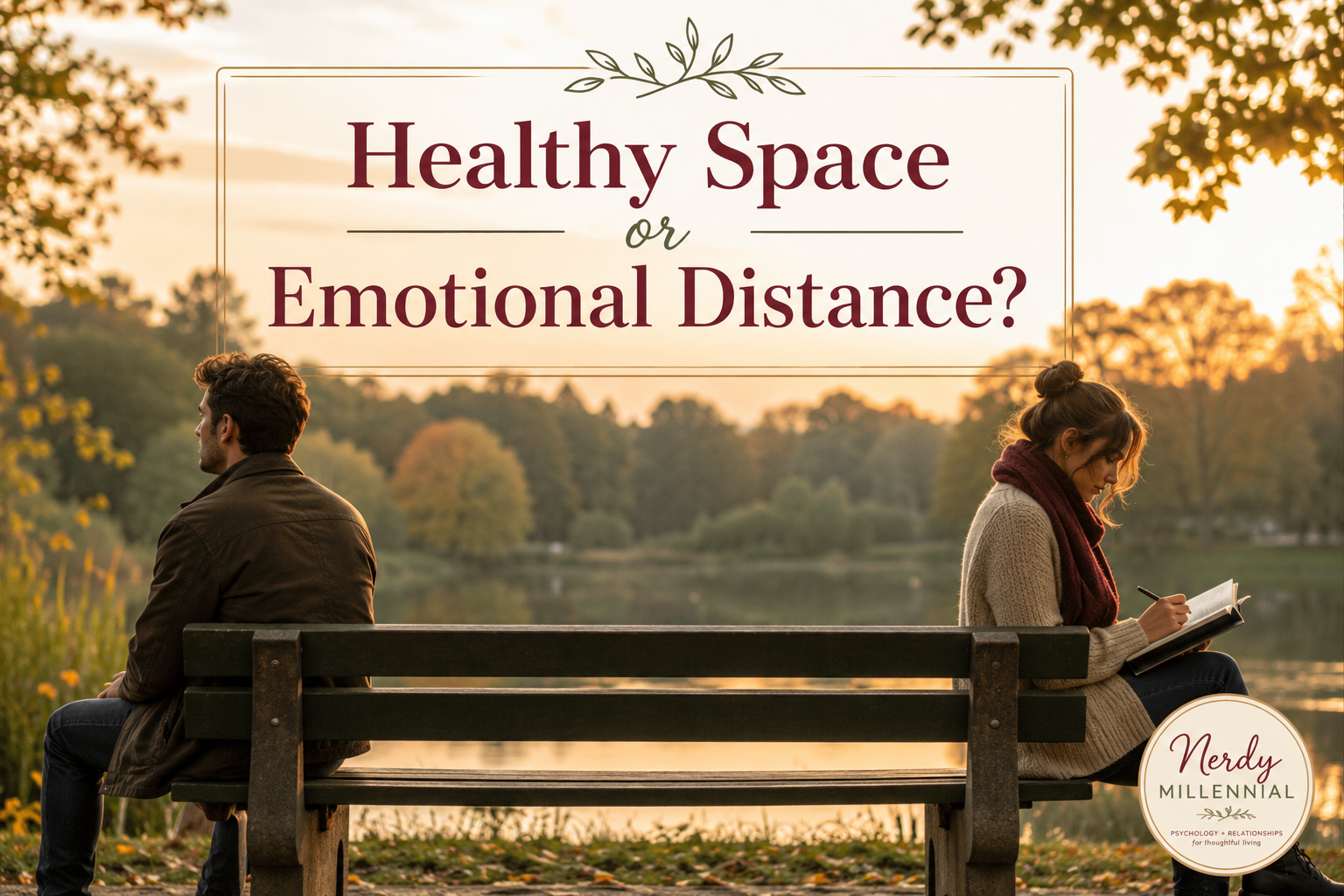
Sometimes two people can spend less time together and actually grow closer. Other times, they can spend every day together while feeling miles apart.
If you’ve found yourself wondering about emotional distance vs. healthy space, you’re asking an important question. When someone you care about starts pulling away, it can be difficult to tell whether they’re simply taking the space they need or whether your emotional connection is beginning to fade.
Maybe they’ve become quieter. They aren’t texting as often. They seem distracted, emotionally unavailable, or ask for more time alone than usual. From the outside, healthy space and emotional distance can look surprisingly similar, making it easy to misinterpret what’s really happening.
Understanding the difference between healthy space and emotional distance can help you respond with clarity instead of fear. Healthy space is often a normal, even beneficial, part of a strong relationship. Emotional distance, on the other hand, may signal that something deeper needs attention. Knowing which one you’re experiencing can change how you communicate, how you interpret your partner’s behavior, and how you care for your own emotional well-being.
As a therapist, I’ve seen many people mistake healthy independence for rejection. I’ve also seen others dismiss growing emotional distance as “just needing space.” In reality, the amount of time two people spend apart tells only a small part of the story. What matters most is whether emotional connection remains intact while they’re apart.
In this article, we’ll explore the key differences between emotional distance vs. healthy space, why they can feel so similar, and the signs that can help you better understand what’s happening in your relationship.
What Is Healthy Space?
Short answer:
Healthy space is intentional time apart that supports both individual well-being and the relationship itself.
Contrary to popular belief, healthy relationships are not built on constant togetherness. They’re built on emotional security.
People need time to recharge, pursue personal interests, spend time with friends, process emotions, or simply enjoy solitude. Having separate experiences often gives partners more to bring back into the relationship.
Healthy space isn’t about creating distance.
It’s about maintaining balance.
Someone taking healthy space may say things like:
- “I’ve had a really overwhelming week.”
- “I think I’d like a quiet evening to myself.”
- “I’m going hiking with a friend Saturday, then let’s have dinner together Sunday.”
Notice that these statements don’t communicate withdrawal—they communicate intention.
Healthy space usually includes reassurance that the relationship is still important.
Signs You’re Experiencing Healthy Space
Although every relationship looks different, healthy space often shares several characteristics.
Communication remains warm.
The frequency of communication may change, but the tone usually doesn’t.
You still feel cared for.
Emotional connection continues.
Your partner still checks in.
They still ask about your day.
They still express affection.
There is an expectation of reconnecting.
Healthy space has a rhythm.
People separate, then come back together.
There is rarely confusion about whether the relationship still matters.
Both people maintain their individuality.
Healthy couples recognize that they are partners—not two halves of one person.
Maintaining hobbies, friendships, careers, and personal interests often makes relationships stronger rather than weaker.
What Is Emotional Distance?
Short answer:
Emotional distance occurs when emotional connection, vulnerability, and responsiveness begin to decrease over time.
Unlike healthy space, emotional distance isn’t primarily about needing time alone.
It’s about losing emotional closeness.
Sometimes this happens intentionally.
Sometimes it happens gradually without either partner fully realizing it.
People become emotionally distant for many reasons, including:
- chronic stress
- burnout
- unresolved conflict
- depression
- anxiety
- trauma
- fear of vulnerability
- attachment wounds
- relationship dissatisfaction
Emotional distance isn’t always a sign that love has disappeared.
Often, it’s a sign that something important needs attention.
Common Signs of Emotional Distance
Instead of simply spending more time apart, emotional distance tends to change how people relate to each other.
You might notice:
- conversations become brief or surface-level
- affection decreases
- curiosity about one another fades
- conflict is avoided rather than resolved
- emotional support becomes inconsistent
- one or both partners stop sharing thoughts or feelings
Many people describe it as feeling lonely while still being in a relationship.
That experience can be deeply confusing because nothing dramatic has necessarily happened.
Instead, the relationship slowly feels less emotionally alive.
Why Emotional Distance vs. Healthy Space Can Feel So Similar
One of the biggest reasons people struggle to distinguish emotional distance vs. healthy space is that the outward behaviors often look almost identical.
Someone may text less frequently.
They may spend more evenings alone.
They may seem quieter or more withdrawn.
They may ask for time to themselves after work or during a stressful season of life.
From the outside, these behaviors can easily be mistaken for signs that a relationship is in trouble. That’s why understanding the difference between emotional distance and healthy space requires looking beyond behavior alone. The real difference lies in the emotional context surrounding those behaviors.
Healthy space usually communicates:
“I’m taking care of myself so I can stay connected with you.”
Emotional distance, on the other hand, often communicates:
“I’m becoming less emotionally available.”
The actions may appear similar, but the emotional meaning behind them is very different.
When you’re trying to understand emotional distance vs. healthy space, ask yourself whether emotional connection continues while you’re apart. Does your partner still express affection, check in with you, and make an effort to reconnect? Or does the distance continue growing without explanation or repair?
Those answers often reveal much more than the amount of time you’re spending together.
Why Our Brains Often Assume Emotional Distance
If you’ve ever immediately thought,
“They’re pulling away.”
or
“They’re losing feelings.”
you’re not irrational.
You’re human.
Our brains are wired to notice changes in important relationships because close relationships are deeply connected to our sense of safety and belonging.
When someone’s behavior changes unexpectedly, your nervous system immediately starts searching for an explanation. Unfortunately, it often fills in the blanks with worst-case scenarios.
That means a perfectly healthy request for space can sometimes feel like emotional distance—even when it isn’t.
This tendency is especially common for people who have experienced:
- inconsistent caregiving during childhood
- previous relationship betrayal
- abandonment
- emotional neglect
- traumatic relationship experiences
- unpredictable relationships
When uncertainty appears, the brain often interprets uncertainty as danger. It would rather prepare you for rejection than risk being caught off guard.
That doesn’t necessarily mean your fears are accurate.
It means your nervous system is trying to protect you based on past experiences.
Understanding this reaction can help you slow down before assuming that a partner’s need for healthy space automatically means emotional distance or the end of the relationship.
How Attachment Styles Influence Emotional Distance vs. Healthy Space
Attachment theory offers another helpful way to understand why emotional distance vs. healthy space can feel so confusing.
People with more anxious attachment tendencies often experience distance as threatening, even when their partner is simply taking healthy space.
Thoughts like these may arise automatically:
- “They’re leaving me.”
- “I must have done something wrong.”
- “They’re losing interest.”
- “They’re going to realize they don’t need me.”
These fears don’t necessarily reflect what’s happening in the relationship. Instead, they often reflect old patterns of trying to stay emotionally safe.
Meanwhile, people with more avoidant attachment tendencies may naturally create greater emotional distance when they feel overwhelmed, stressed, or emotionally flooded. Pulling back can feel like their way of regulating difficult emotions rather than rejecting the relationship.
Neither response is inherently “right” or “wrong.”
They’re adaptive strategies that people develop over time to protect themselves and maintain emotional safety.
The challenge occurs when partners interpret each other’s coping strategies without understanding the underlying need.
Someone asking for healthy space may genuinely be trying to regulate themselves—not push their partner away.
Likewise, someone asking for reassurance isn’t necessarily “too needy.” They may simply be seeking emotional safety and connection.
Recognizing these attachment patterns can make it much easier to distinguish emotional distance vs. healthy space and respond with curiosity instead of fear.
Therapist Perspective
One pattern I frequently see in therapy is couples arguing about behavior when what they really need to understand is meaning.
One partner says,
“I just need a little space.”
The other hears,
“I don’t want to be with you anymore.”
Neither person is necessarily wrong about what they’re experiencing.
They’re simply interpreting the same situation through different emotional histories.
One partner is focused on reducing overwhelm.
The other is focused on protecting connection.
When couples slow down enough to talk about why someone needs space—and what staying connected during that time looks like—the conversation often changes completely.
The goal isn’t to eliminate space.
The goal is to create enough emotional safety that space doesn’t automatically feel like abandonment.
Healthy Space vs. Emotional Distance: A Side-by-Side Comparison
One of the easiest ways to understand the difference between healthy space and emotional distance is to look beyond the amount of time people spend together and focus on what happens emotionally during that time.
| Healthy Space | Emotional Distance |
|---|---|
| Time apart feels intentional. | Time apart feels confusing or unexplained. |
| Communication remains warm. | Communication becomes brief or emotionally flat. |
| Affection continues. | Affection noticeably decreases. |
| Both partners expect to reconnect. | Reconnection rarely happens naturally. |
| Boundaries create security. | Distance creates uncertainty. |
| Individual growth strengthens the relationship. | Emotional disconnection weakens the relationship. |
| Problems are discussed eventually. | Problems are avoided indefinitely. |
No relationship fits perfectly into one column all the time.
Healthy couples sometimes become emotionally distant during periods of intense stress. Likewise, couples experiencing emotional distance can often rebuild closeness through intentional communication and repair.
The important question isn’t, “Are we spending less time together?”
Instead, ask:
“Do we still feel emotionally connected while we’re apart?”
Questions to Ask Yourself
When emotions are running high, it’s easy to search for certainty.
Unfortunately, relationships rarely provide simple answers.
Rather than trying to guess what your partner is thinking, it can be more helpful to become curious about the overall pattern.
Consider asking yourself:
- Has communication changed in both frequency and emotional quality?
- Do I generally feel emotionally safe with this person?
- When they ask for space, do they also make efforts to reconnect?
- Is this a temporary change related to stress, or has it become a long-term pattern?
- Have I expressed how this change is affecting me?
- Are we both making efforts to understand each other’s needs?
Notice that none of these questions ask whether someone “really loves you.”
That’s because love is rarely the only variable at play.
Stress, grief, anxiety, work demands, parenting, illness, trauma, and life transitions can all temporarily affect emotional availability.
Looking at the broader picture usually provides much more useful information than focusing on one isolated behavior.
A Real-World Example
Imagine a couple, Maya and Ethan.
Ethan has been preparing for an important certification exam while balancing a demanding job. Over the past two weeks, he’s been quieter than usual and spends several evenings studying alone.
At first, Maya worries he’s losing interest.
But Ethan continues checking in throughout the day. Before studying, he tells her, “I’m really looking forward to spending Saturday together after this exam.” He hugs her before bed, asks about her work, and follows through on their weekend plans.
Although they’re spending less time together, the emotional connection remains intact.
Now imagine a different situation.
Another partner begins spending increasing amounts of time away, rarely initiates conversations, stops sharing thoughts or feelings, avoids discussing concerns, and responds to questions with, “I’m fine,” despite obvious tension.
Weeks pass without meaningful attempts to reconnect.
In that situation, the issue is no longer simply needing space.
It’s the gradual erosion of emotional intimacy.
The behaviors may appear similar from the outside, but the emotional experience inside the relationship is entirely different.
When Healthy Space Becomes Emotional Distance
Healthy space isn’t something that happens once.
It’s part of an ongoing cycle.
Healthy relationships naturally move between closeness and independence.
The problem arises when the relationship never returns to closeness.
Sometimes healthy space gradually shifts into emotional distance because life becomes overwhelming.
Other times it happens because unresolved conflict quietly accumulates.
Couples stop having difficult conversations.
Small disappointments go unspoken.
Resentment builds.
Eventually, emotional withdrawal begins to feel easier than vulnerability.
This transition is often subtle.
Few people wake up one morning and decide to become emotionally distant.
Instead, distance usually develops through dozens of small moments of missed connection.
Psychologist John Gottman describes these opportunities as “bids for connection”—the everyday attempts partners make to engage with one another. Responding to those bids consistently helps maintain emotional intimacy, while repeatedly missing them can gradually increase distance.
What Should You Do If You’re Unsure?
One of the most understandable responses to uncertainty is trying to eliminate it as quickly as possible.
You might feel tempted to repeatedly ask for reassurance, monitor your partner’s behavior, or assume the worst before you can be hurt.
Although understandable, those reactions often increase anxiety rather than resolve it.
Instead, try approaching the situation with curiosity.
You might say:
“I’ve noticed we’ve seemed a little more disconnected lately, and I wanted to check in about how you’re doing.”
That invitation creates room for conversation without placing someone immediately on the defensive.
At the same time, don’t ignore persistent emotional distance simply because you’re hoping things will improve on their own.
Healthy relationships involve repair.
If one partner consistently avoids reconnecting despite repeated, respectful efforts, it may be important to have a more direct conversation about the health of the relationship.
Therapist Perspective: Look for Patterns, Not Moments
One of the biggest mistakes I see is people making major conclusions based on isolated moments.
A stressful week at work isn’t necessarily emotional withdrawal.
A quiet weekend doesn’t automatically mean the relationship is in trouble.
Likewise, a single affectionate evening doesn’t erase months of emotional disconnection.
Patterns tell a much more accurate story than individual moments.
Rather than asking, “What did they do today?”, try asking:
“What has our relationship looked like over the past several weeks or months?”
That broader perspective often provides much greater clarity.
Frequently Asked Questions
Does asking for space mean the relationship is over?
Not necessarily. Many people ask for space because they’re overwhelmed, emotionally exhausted, or trying to regulate themselves—not because they want to end the relationship. What matters most is whether they continue investing in emotional connection afterward.
Can emotionally distant people still love their partners?
Yes.
Love and emotional availability are not the same thing.
Someone can care deeply while struggling to express closeness because of stress, depression, trauma, attachment patterns, or unresolved conflict.
That doesn’t mean emotional distance should be ignored, but it does mean its presence isn’t automatically evidence that love has disappeared.
How much space is healthy in a relationship?
There isn’t a universal amount.
Healthy space depends on the needs of both partners.
Some couples naturally spend large amounts of time apart while remaining emotionally connected. Others prefer more shared time.
The healthiest balance is one that leaves both people feeling respected, connected, and secure.
Can emotional distance be repaired?
Often, yes.
If both partners are willing to communicate openly, rebuild trust, and intentionally reconnect, many relationships recover from periods of emotional distance.
The sooner the underlying issues are addressed, the easier that process tends to be.
Final Thoughts
Every relationship naturally moves between closeness and independence.
The healthiest partnerships don’t avoid distance altogether—they learn how to navigate it together.
Healthy space creates room for individuals to grow while preserving emotional connection.
Emotional distance, on the other hand, slowly weakens that connection when it goes unaddressed.
If you’re unsure which one you’re experiencing, try shifting your focus away from individual behaviors and toward the overall pattern.
Ask yourself:
- Is there warmth behind the distance?
- Do we reconnect after time apart?
- Do we still feel emotionally safe with one another?
Those questions often reveal far more than counting text messages or measuring hours spent together.
Ultimately, strong relationships aren’t built by never needing space. They’re built by knowing how to find your way back to each other.

Drawing from years of clinical experience working with children, teens, adults, and families, Vanessa writes about psychology, communication, emotional wellness, personal growth, and the patterns that shape human behavior. Her work blends evidence-based mental health principles with practical, accessible insights designed to help readers better understand themselves and their relationships.
Vanessa incorporates trauma-informed, attachment-focused, EMDR, and play therapy approaches in her clinical work. As a Registered Play Therapist™, she has advanced training in helping children communicate, process emotions, and heal through developmentally appropriate therapeutic interventions.
When she isn't providing therapy, supervising clinicians, or running a counseling practice, Vanessa enjoys exploring the intersection of psychology, storytelling, healing, and personal transformation through writing and education.
- Emotional Distance vs. Healthy Space: How to Tell the Difference - July 2, 2026
- What Does “I Need Space” Really Mean in a Relationship? - June 20, 2026
- Why Video Games Aren’t Ruining Your Child’s Brain - June 7, 2025